BACKNINESTRONG Get the app

Know your number inside 120 yards.

Wedge Matrix turns your real carry distances into a yardage chart for every wedge and every swing. Zap the pin, enter the number, and it tells you the club and the swing.

Free to download. Pro is a one-off £2.99. Used by golfers in 15 countries.

Try it. Pick a distance to the pin.

72yards
Knee¼ Belt½ Shoulder¾ Full 

Sample bag. Yours is built from your own shots.

Your full swings are dialled. Your wedges are guesswork.

Most club golfers can tell you their 7-iron carry to the yard. Ask about a half-swing gap wedge and you’ll get a shrug.

That gap is where scores leak: the 60-yarder that finishes 15 short, the knockdown that flies the green, the three-quarter you hit because it “felt about right”.

Wedge Matrix fixes it with numbers you collect yourself, not a chart from a magazine. And when your approach finishes pin high, the putting gets easier too: shorter first putts, far fewer three-putts.

Four swings you can see, not guess

Ask four golfers to hit a half wedge and you’ll get four different swings. Ask them to take their hands back to belt height and you’ll get one.

Fractions

¼, ½, ¾. A feeling. It changes with nerves, wind and how the last one went.

Landmarks

Knee, belt, shoulder, full. A position you can check against your own body, every time.

Relatable

Everyone knows where their knee, belt and shoulder are. No maths on the tee, no arguing about what “half” means.

Measurable

You can check it in a mirror, on video, or by feel. If the length of the swing is the same every time, the yardage you log for it actually means something.

Built for consistency

Fix the length of the backswing and the main thing left to vary is your strike. That’s exactly what your Ability Band measures, so every shot you log sharpens a number you can trust.

Try it. Tap a swing.

Shoulder Belt Knee

Face-on view of a right-handed golfer. Sample carries from the bag at the top of the page.

Your wedges decide your putts

Every yard you miss your number by is three more feet of putt. Those feet add up faster than you’d think.

  • 3% vs 13%How often a scratch golfer three-putts, against a 25-handicapper.
  • 3 in 4 vs under halfMake rate from 3–6 feet: scratch against a 25-handicapper.
  • Distance, not strokeThe gap between good and bad putters comes mostly from how far away they start and how well they control pace, not short-putt technique.

Hit your wedge number and you start closer. Start closer and the three-putts start disappearing. That’s exactly what happened to my game this year.

Tour odds: PGA Tour ShotLink, via Golf Magic. Amateur figures: Shot Scope data, via MyGolfSpy.

Try it. Where did your approach finish?

15feet from the hole
One-putt
Two-putt
Three-putt+

PGA Tour averages. Club golfers do worse from every distance, especially from long range.

Four steps to a matrix you trust

This is the actual app, not a mock-up. Range to green, it’s all on your phone.

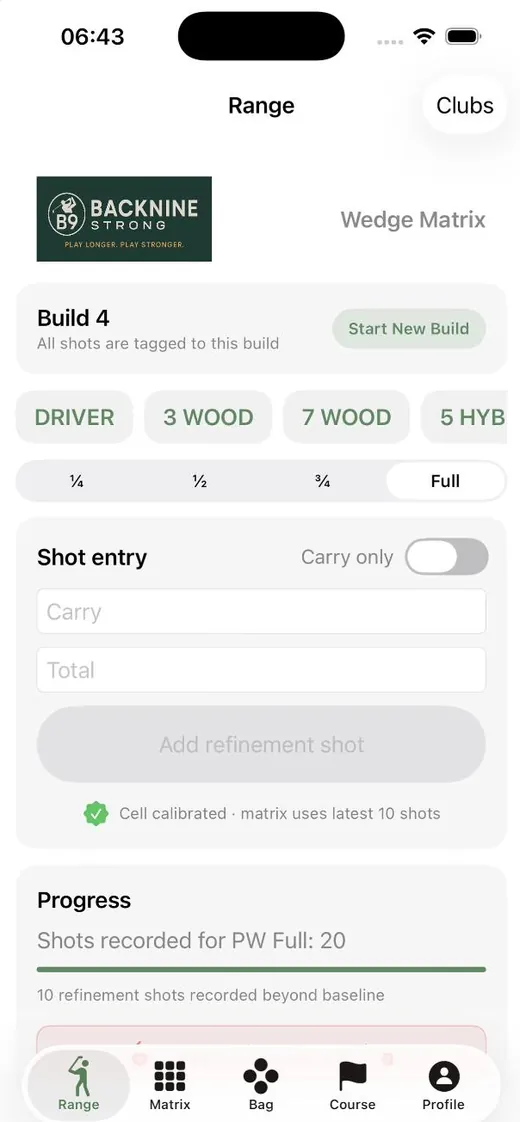
  1. Range screen: choose a club and swing, then enter carry and total for each shot

    Log your shots

    Pick the club and the swing, then enter each carry (and total, if you have it). Range, sim or launch monitor, it all counts. After 10 shots the cell is calibrated, and from then on it uses your latest 10.

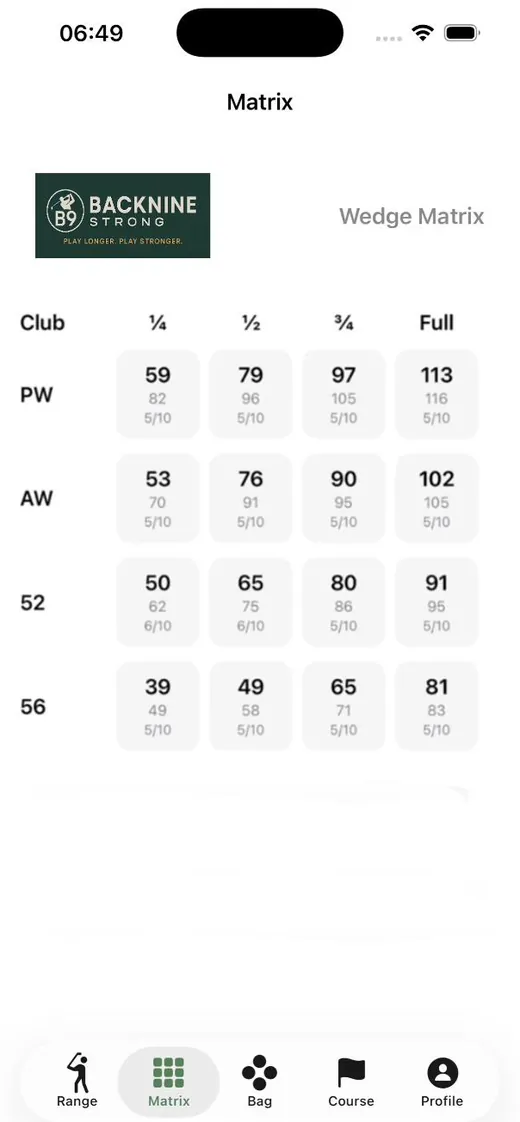
  2. Matrix screen: a grid of average carry and total for each wedge and swing

    Build your matrix

    Every wedge, every swing, in one grid. Each cell shows your average carry, your average total and how many shots it’s built on.

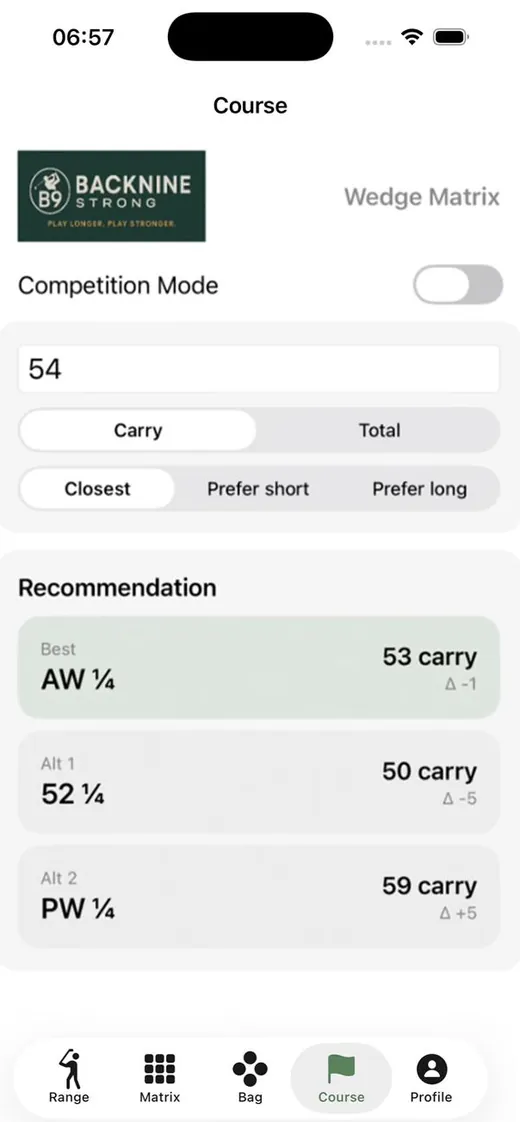
  3. Course screen: enter 54 yards and get AW as the best club, with two alternatives

    Play the number

    Enter the distance from your rangefinder. Choose carry or total, and whether you’d rather be short or long. You get the best club and swing, plus two alternatives.

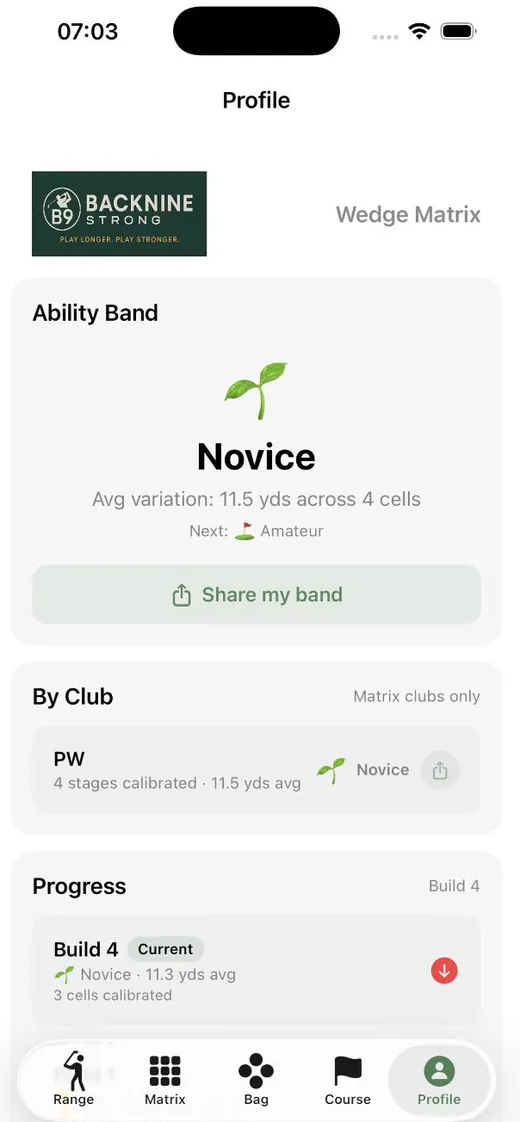
  4. Profile screen: Ability Band, band by club and progress by build

    Watch your band climb

    Your Profile shows your Ability Band for each club, how it’s trending build by build, and a card you can share when you move up.

Swipe for all four steps.

Start your matrix free

See how consistent you really are

Your average carry tells you where the ball goes on a good day. Your Ability Band tells you how often you actually get there.

What gets measured

The spread of your carries, worked out as a standard deviation: roughly how far a typical shot lands from your average. A 60-yard half swing with a spread of 4 yards is a club you can trust. The same average with a spread of 10 is a coin toss.

Why spread, not average

Anyone can hit a lucky 60. Spread shows whether you can do it on demand, and on the course that’s the difference between pin high and a long first putt.

Ten shots, every swing

A band needs at least 10 logged shots before it’s assigned, so one good session can’t flatter you. Each club and swing length gets its own band, so your shoulder-height sand wedge can be Scratch while your knee-height lob wedge is still Novice.

Always your last 10

The band uses your most recent 10 carries, so it moves as you improve. The app shows the trend over time and marks the moment you move up a band.

Anchored to TrackMan

The band boundaries are set against TrackMan launch monitor data, so Tour Level means tour-level consistency, not a pat on the back.

Try it. How consistent is your 60-yard wedge?

Ten sample carries aimed at 60 yards. The shaded strip is where about two in three shots land.

Tour Levelspread under 3 ydswindow under 6 yds
Scratchspread 3–4.5 ydswindow 6–9 yds
Competitorspread 4.5–6 ydswindow 9–12 yds
Club Playerspread 6–8 ydswindow 12–16 yds
Amateurspread 8–10 ydswindow 16–20 yds
Novicespread over 10 ydswindow over 20 yds
Tighter spreadWider spread

Window: the stretch of ground about two in three of your shots land in, front to back. Compare it to the depth of the greens you play.

Find your band

Free to start. £2.99 for the lot.

No subscription. Pay once, keep it.

Free

£0
  • Track every club in your bag
  • 10 carry and total entries per club
  • Averages worked out for you
  • Range View and Bag View

Pro

£2.99 one-off
  • Everything in Free
  • The full Wedge Matrix: knee, belt, shoulder and full for every wedge
  • Course view: enter a distance, get your club and swing

Download free on the App Store

Built by a golfer who got tired of guessing

6.7In my twenties
22After 15 years away
13Before Wedge Matrix
8.6This year, with Wedge Matrix

I learned the game walking the course with my dad. I got down to 6.7 in my twenties. Then marriage, three kids and a full-time job happened, and I didn’t touch a club for 15 years.

When I came back I was a 22, and the part of my game that hurt most was inside 120 yards. I knew my full swings. Everything shorter was a guess.

So I built the tool I wanted. Log real shots, build a matrix, stop guessing. One year of using it and I’ve gone from 13 to 8.6.

The surprise wasn’t just the wedges. Knowing my number means I’m leaving myself shorter, more makeable putts, and the three-putts have all but disappeared. That’s where the shots really came from.

Back Nine Strong started as a way to keep playing the game I love for as long as I can. Wedge Matrix is how I’m playing it better.

Darran CookeFounder, Back Nine Strong

Try Wedge Matrix free

Follow the journey from 22 to 8.6, and beyond

Short game tips, wedge data and the odd shank. Questions about the app go straight to me.